
You're Setting 94% of Your AI Budget on Fire.

We asked Claude the same research question two ways. Reading raw call transcripts took 14.8× more tokens than reading Four/Four insights, and the answer came out the same.
Right now every revenue, customer and product team is plugging a "conversation MCP" into their LLM. The tool exposes a pile of call transcripts, the model reads them, and everyone calls it AI-native customer research.
Nobody seems to be checking the bill. A transcript is mostly small talk, screen-share narration, "can you see my screen?" and your own team talking. The model pays for every one of those words, on every question, every time.
We build Four/Four, which turns conversations into structured, cited insights and topic sets. We wanted a hard number for what that structure is worth to an LLM, so we ran a controlled test on our own data.
The experiment
Questions like: "What are the top pains for people with a Product persona?" It's the kind of thing a PM, a founder or a product marketer asks every week.
We ran these questions through two separate Claude agents, each restricted to one way of seeing the data:
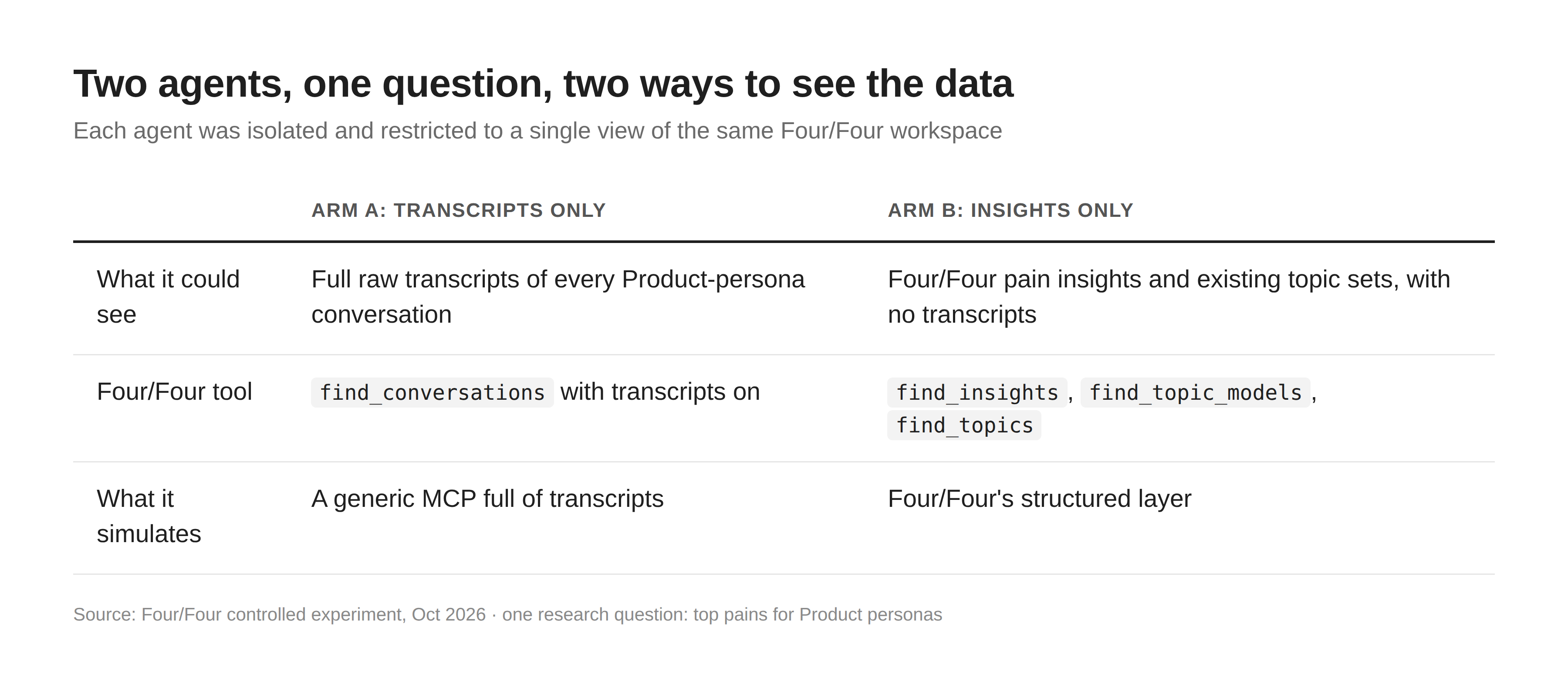 Neither agent could see the other's work, so arm B couldn't reuse anything arm A had already found. Both were told to give a ranked list of pains, with counts and a citation for every claim.
The results
Over the full dataset, transcripts made the model read 2.86M tokens. Insights needed 194k: 93% less, for the same question.
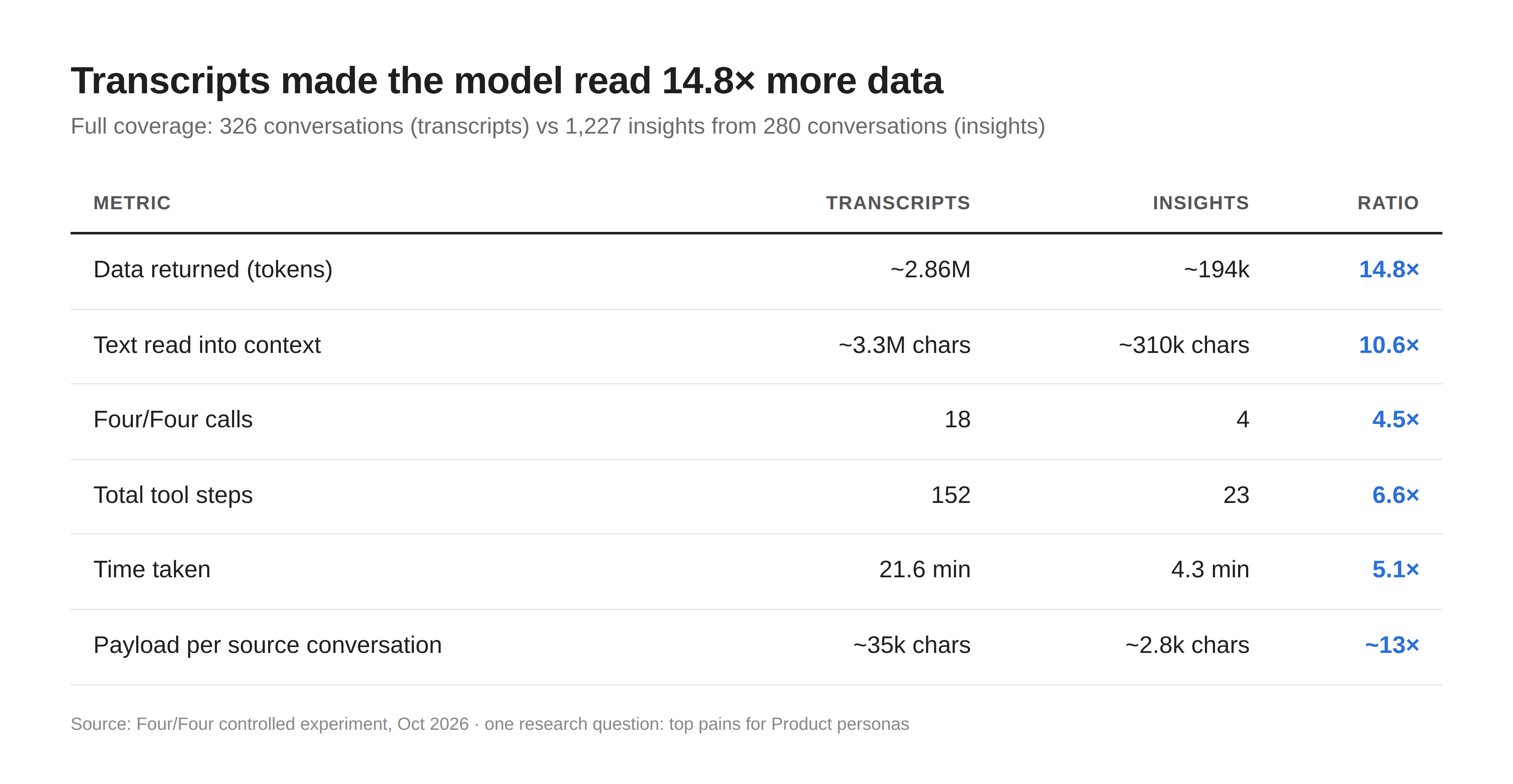 The ugliest finding didn't make it into the table. A standard transcript MCP couldn't have done this at all. One page of 20 transcripts came to about 860k characters, more than a model's context window.
Our agent only got through because its tool output was saved to disk and filtered with scripts. Plug the same transcripts into a normal chat client and it either fails or quietly drops most of the data.
Did the cheap route give a worse answer?
No. Both agents independently put the same four pains at the top.
The insights route covered more accounts (122 against about 100). Every insight is already linked to its account, while the transcripts agent had to work out account names from call metadata.
What it costs in real money
On Claude Opus 5.5, one research question cost $11.44 in input tokens using transcripts and $0.78 using insights. Opus 5.5 charges $4 per million input tokens, with no long-context surcharge.
Nobody stops at one question, though. We modelled three typical follow-ups:
- a cut by enterprise accounts
- a drill-down into the evidence for one pain
- the trend over the last six months
Each follow-up forces the transcript route to re-read about 100 full conversations. The insights route just runs a narrower filter.
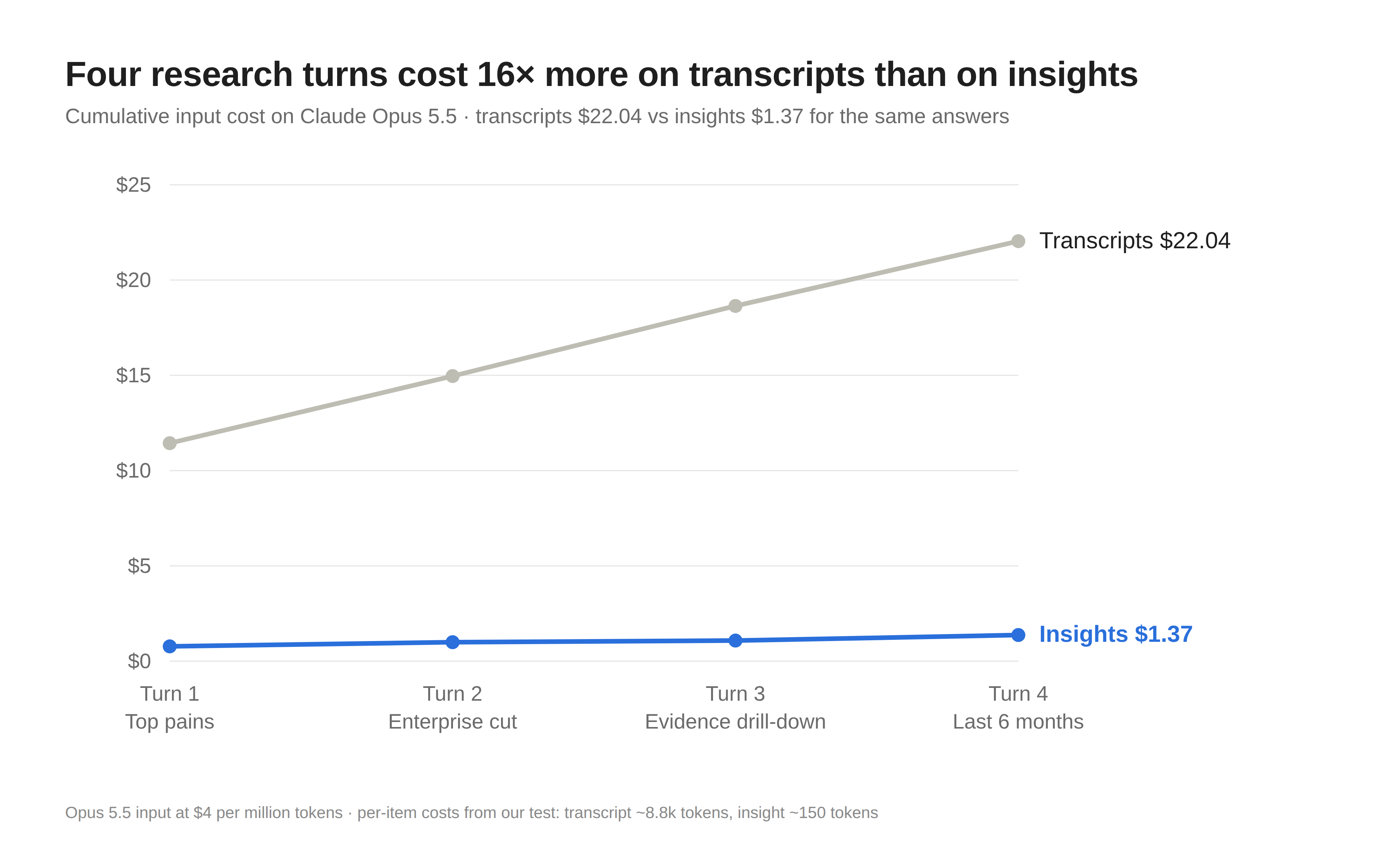 Opus 5.5 input at $4 per million tokens. Per-item costs from our test: transcript ~8.8k tokens, insight ~150 tokens.
The narrow follow-ups are where it hurts most. Pulling the evidence for a single pain is about 44× cheaper with insights, because the filter returns roughly 140 relevant sentences rather than 105 hour-long calls.
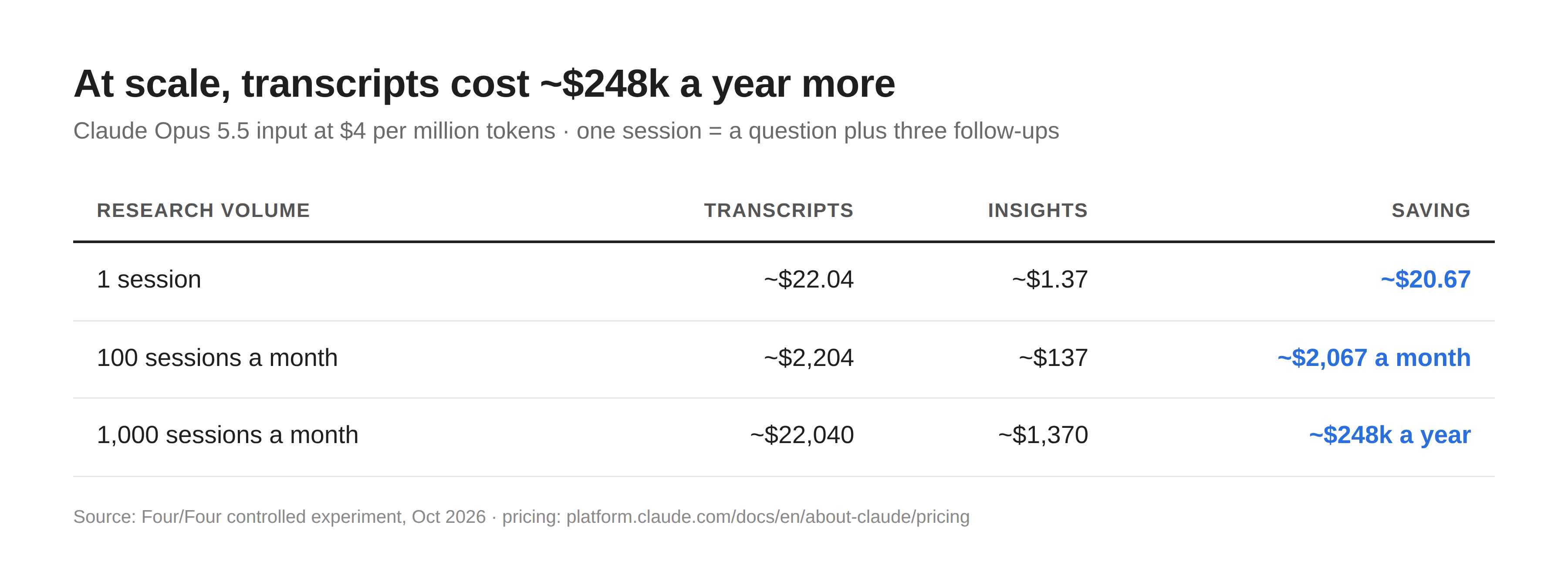 These figures are a floor. Prompt caching makes re-read context ten times cheaper ($0.20 per million tokens). The insights working set (~78k tokens) fits in context and can be cached between turns. The transcript data doesn't fit, so it has to be fetched and paid for again on every turn.
What we're not claiming
- It's our own data and our own product. The method above is laid out so anyone can rerun it on theirs.
- Insights aren't free to make. Four/Four does the extraction once, at ingestion. The point is that you pay for it once, instead of on every question your team or your agents ever ask.
The takeaway
Giving your LLM raw transcripts isn't a research strategy. It's a tax. It's a tax on every question, every follow-up and every agent run, and it grows with every call you record. You pay roughly 15× more to get the same answer more slowly, from a tool that buckles at any real scale. Structure is what makes AI research affordable. Extract the pains, needs, requests and evidence once. Tie each one to the account, the persona and the exact moment in the call. Then let the model reason over the signal rather than the small talk.
If your conversation MCP returns transcripts by default, try this test on your own data. Then look at your bill.