Unifying product and commercial’s view of the customer

Rob Dumbleton 2026-04-12
#sales #executive #customer-success #product #marketing
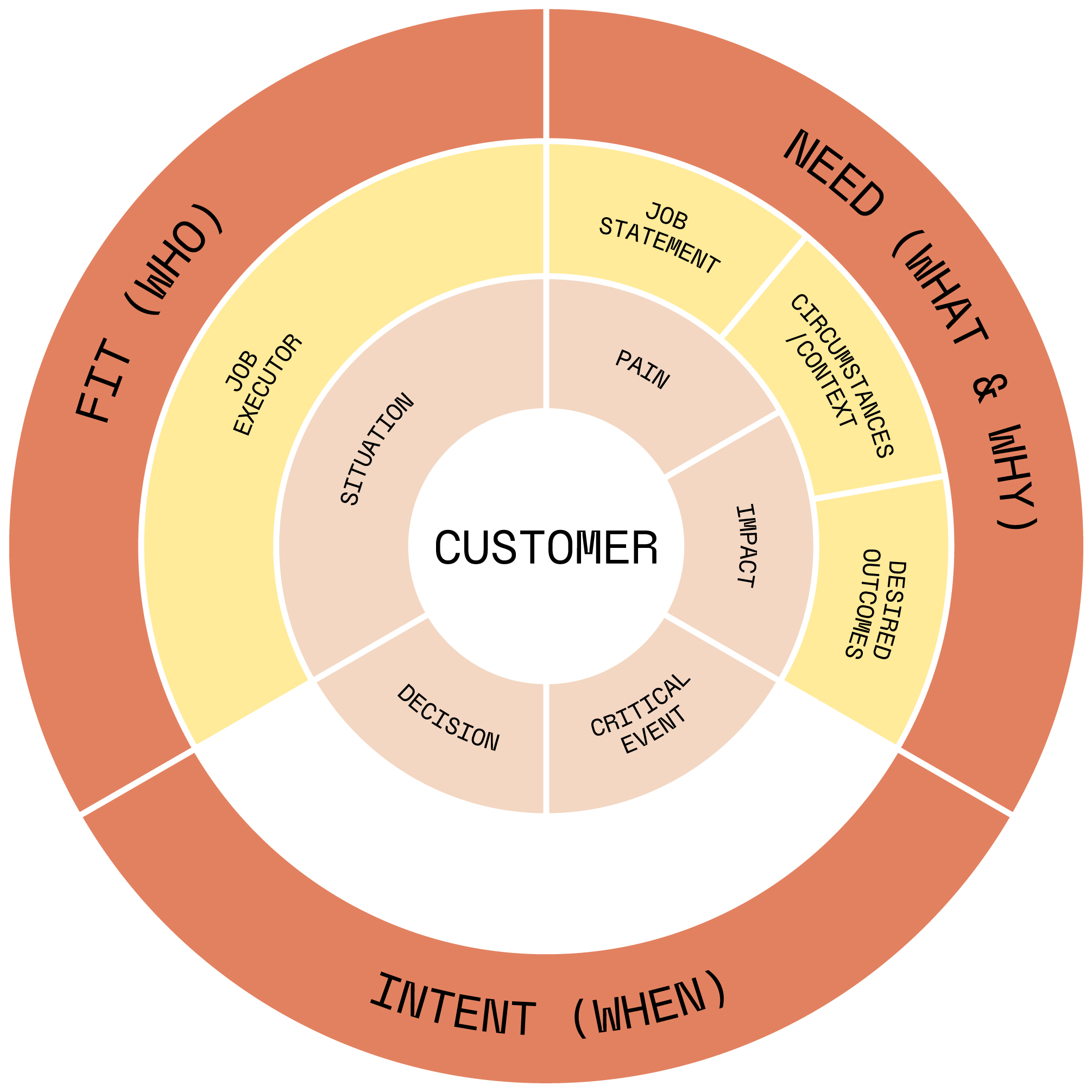
Good sales and product methodologies will focus on discovering the needs of the customer. We’ve baked the principles of many market-leading customer-centric discovery methodologies into the way Four/Four interprets and extracts insights.

Two of the main methodologies we use are Jobs-to-be-done (JTDB) from the product world and SPICED from the sales and commercial world.

Product Lens - JTBD

The Jobs-to-be-done (JTBD) methodology is a framework for understanding customer needs by focusing on the underlying goal or "job" they are trying to accomplish, rather than just demographic data .

Job Executor: The person actively getting the task done.

Job Statement: A clear description of what the user wants to accomplish (e.g. "Pass on life lessons to my children," not "Buy a book").

Circumstances / context: The specific situation or environment where the job arises (e.g."When commuting to work...").

Desired Outcomes: The metrics customers use to measure success in getting the job done (e.g. "minimise the time it takes to...").

Commercial Lens - SPICED

The SPICED methodology, developed by Winning by Design, is a customer-centric sales framework designed for to diagnose client needs rather than just pitching products.

Situation: Industry, tech stack, size.

Pain: How the prospect describes the difficulties they are having and problems they want to overcome.

Impact: What the value would be of resolving the issues.

Critical Event: Determining the specific deadline or trigger for action.

Decision: The criteria for purchase.

How we create and classify insights to help with your single view of the customer

Jobs

Derived from the Jobs To Be Done methodology, a "job" is a task the speaker has specifically mentioned as something they are trying to achieve. Jobs are written in the form "I want to do X so I can achieve Y"

Jobs break down into five categories:

Sales: A job relating to a part of the sales process such as requesting pricing, understanding competitors and signing contracts.

Non-functional: A job the speaker needs to perform, but not necessarily through a function of the product or solution being discussed. Such as driving usage and adoption, preparing reports for other teams or satisfying IT and Security departments.

Functional: A job the speaker needs to perform that they expect or require the product or solution being discussed to perform. These will likely be specific to your offering.

Deployment: A job relating specifically to the implementation or deployment of the product or solution. Such as integrating with other systems, planning a rollout and user training.

None: This "other" category captures jobs that do not appear to fit into any of the above categories, but appeared to still be related to a task the speaker needs to perform.

Solutions

Solutions are insights collected from internal participants with a role like "Sales Engineer" or "Solution Consultant". They capture where an expert is describing to a prospect or customer how their goals can be achieved using your product or service.

Consultants are often discussing how software will work in the customer's environment, and sometimes how processes need to be changed or customizations implemented to meet the need. These insights can therefore be highly valuable to customer success and product teams in understanding how the solution was presented as meeting the customer's needs. They may also be used for internal training, to ensure functionality is being uniformly presented across the consulting team.

Solutions come in one of these categories:

Process: The consultant describes how the customer can change a process on their side to use functionality in the product.

Customize: The consultant describes how the product can be customized to meet the customer's need.

Feature: The consultant describes how existing functionality meets the customer's need.

None: The consultant describes that the product cannot meet the need being discussed.

Pain and Impact

Derived from the SPICED methodology, Pain and Impact insights relate to how the prospect describes the difficulties they are having and problems they want to overcome, and what the value would be of resolving these issues.

Both Pain and Impact can be described Emotionally or Rationally. These have particular value to marketing teams trying to understand how the customer articulates their difficulties and the language they use, to design messaging campaigns.

Needs analysis

Needs analyses are generated during conversations at a very early stage in the sales pipeline, normally the first call a business development representative might have with a prospect.

These insights attempt to capture the prospect's immediate understanding of the presented value proposition, and whether they believe it applies to their situation.

Needs analyses fit into one of these categories:

Undiscovered need: The prospect does not recognise the value of the proposition, or does not believe it applies to their situation.

Discovered need: The prospect agrees that the proposition has value, and recognises that it applies to their situation.

Intent: The prospect agress with the value proposition, and is actively seeking a solution for their situation.

Tasks

Tasks are extracted from support tickets (if integrated) and represent the reason for the support request itself, and any tasks completed during its resolution.

Features

Features are types of requests made for changes or enhancements to the product being discussed.

Features fit into one of these categories:

Request: A direct request for a new product feature or capability the speaker wants.

Enhancement: Functionality that the product partially has or could be configured to perform, but which needs improvement.

Configuration: Additional configuration options needed to meet the speaker's requirements.

Service: Additional services or support such as training that will assist with their use of the software. These are not necessarily technical in-product features, but could be additional services the audience is interested in.

We use cookies as specified in our Privacy Policy. You agree to consent to the use of these technologies by clicking Allow Cookies.